Siebel Home
Doemens
Sign Up

Site Map

NEW! Siebel Institute Professional
Beer Tasting & Styles Course

Designed and Conducted by Randy Mosher


Click here to see a complete list of courses and dates

For upcoming dates & course tuition costs, click here to download our complete 2008 catalog & registration forms in Acrobat PDF format

BASIC-LEVEL BREWING COURSE
No prior brewing knowledge required

Also available as a Siebel Institute “On-Site Training” course. (See the “On-Site Training” course page for complete information)

Solid information has never been a more critical tool in brewing & selling beer. Specialty beers offer great profit opportunities, but consumers of beer are becoming highly sophisticated in their knowledge of beer. It is important that brewers, distributors and retailers keep up with them in order to offer products and programs that satisfy their thirst for exciting new beer experiences.

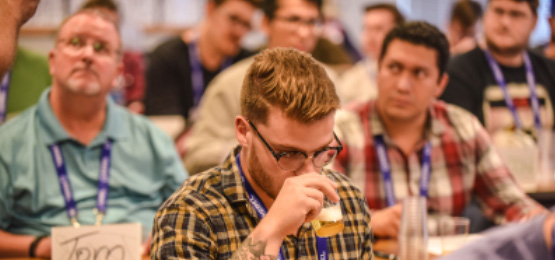
The Siebel Professional Beer Tasting & Styles Course is a two-day hands-on workshop that gives participants a solid foundation of beer knowledge, with a special emphasis on beer styles and tasting. By the end of the course, attendees will have a working knowledge of the origin and nature of beer, tasting methods and a wide range of classic and modern beer styles as well as how to present the beer experience so as to make it fully enjoyable to their customers. Numerous detailed leave-behinds summarize and expand key points and provide a handy reference on selected topics.

There are many misconceptions about beer, and more than a few of the terms used to describe it can be confusing. This course addresses these, and builds knowledge from the ground up, giving participants the building blocks to understand beer in all its many glorious forms.

This course can be customized to provide additional detail and discussion of a distributor’s, importer’s or retailer’s beers, and those beers can be included in the appropriate style tasting as well as the beer-and-food pairings.

Two-day Course Outline:

Section 1 Introduction

What is Beer?
Beer in Context
     A widespread product
     Lifestyle & Diet
     Culture
     Seasons
A Little Beer History
     Beginnings in the Ancient World
     Medieval to Modern, Gruit to Hops
     The Industrial Revolution
     The American Beer Story
     Craft Beer Revolution

Section 2 - Sensory

Physiology and Psychology
Taste
Smell
Techniques for Sensory Evaluation
Practical Tips for Evaluating Beer
Sources of Flavor & Aroma
The Taste of Beer
Beer Aroma & the Flavor Wheel
The Formal Tasting
     Types of Tastings
     Competitive Judging
     Evaluation Forms
Informal Tastings
Settings & Methods
Tasting Glasses

Section 3 - Beer by the Numbers

Gravity (Strength of “wort” or unfermented beer)
Alcohol
Color
Bitterness
A Question of Balance

Section 4 - Common Defects of Beer
(including tasting of beers spiked with off-flavors)

Raw materials
Brewhouse
Fermentation/maturation
     Yeast
     Infection
Packaging
Mishandling
     It’s old!
     It might be the draft line
     Light

Section 5 - The Process of Brewing
(and why you should care)

Beer Ingredients (including smelling/tasting samples)
     Malt
     Other Grains & Fermentables
     Hops
     Water
     Yeast
     Other ingredients
The Brewing Process
     Malting
     Mashing
     Boiling
     Chilling
     Fermenting
     Maturation
     Filtration & Pasteurization
     Storage & Shipping

Section 6 - What Is a style?

The styles sections below feature a combination of lectures, slides and tastings, giving a thorough overview of the character of the styles.

Section 7 - Ales of the United Kingdom

The Pale Ale Family: Bitter, ESB, Pale, IPA
Brown & Mild Ale
Scottish and Scotch Ales
Porter
Stout
Old & Strong Ales
Barley Wine
New British Styles

Section 8 - Lager
The classic styles of Europe: Germany & Czech Republic

Pilsner
Helles
Märzen/Vienna/Oktoberfest
Alt & Kölsch
Munich Dunkel
Maibock & Bock
Weisse & Weizen
American Lagers & Related Styles
American Adjunct Pilsner
Classic Prepro Pilsner
Cream Ale
Steam Beer

Section 9 - European Ales

Düsseldorfer Altbier
Kölsch

Section 10 - Belgium & France

Trappist & Abbey Ales
Strong Ale
Saisons
French Bière de Garde
Witbier
Artistic Beers
Lambic
Sour Brown & Red Beers
Belgian Fruit Beers

Section 11 - New American Classics

Amber & Red Ales
American Pale/IPA
Hyper-Hoppy Imperials
Barrel-Aged Ales
Super-Strong Beers
Fruit, Spice & Vegetable Beers

Section 12 - Serving & Storing Beer

Aging beer
     When and Why
     Suitable Types
     Conditions
Serving Temperatures by styles
Beer Glassware
     What Matters and What Doesn’t
     Historical & Classic
     Tasting Glasses

Section 13 - Beer & Food

Why is beer so good with food?
Pairing Approaches
Classic Combinations
Some Surprising Pairs
Beer & Cheese
Beer with Desserts
Beer Cuisine
Beer & Food Tastings & Dinners

In addition to lecture/slides, the last part of this section features a tasting of beers paired first with several different cheeses, then with several different dessert items. Participants are encouraged to discover pairings that work especially well. This is always a surprising and well-received experience.

Leave-Behinds
     Bound printouts of PowerPoint lecture slides
     Beer Color Guide
     Beer Flavor Wheel
     World Beer Cup Beer Detailed Style Guidelines
     Glossary of Common Beer & Brewing Terms
     Food & Beer Styles Pairing Guide
     Bibliography of Useful Beer Books

   
Copyright © 2008

Siebel Institute of Technology - America's Oldest Brewing School